On Tuesday, for the second time in less than three months, a strong earthquake shook Colombia.
Centered in the department of Tolima, the tremor was felt in major cities across the country, including Ibagué, Cali, and Bogotá, forcing residents to evacuate their homes in the early morning, around 4:00AM.
While no major structural damage or injuries were reported this time, another conversation took center stage: the mental strain and emotional toll on a society that is still recovering from the devastating August 10 earthquake.
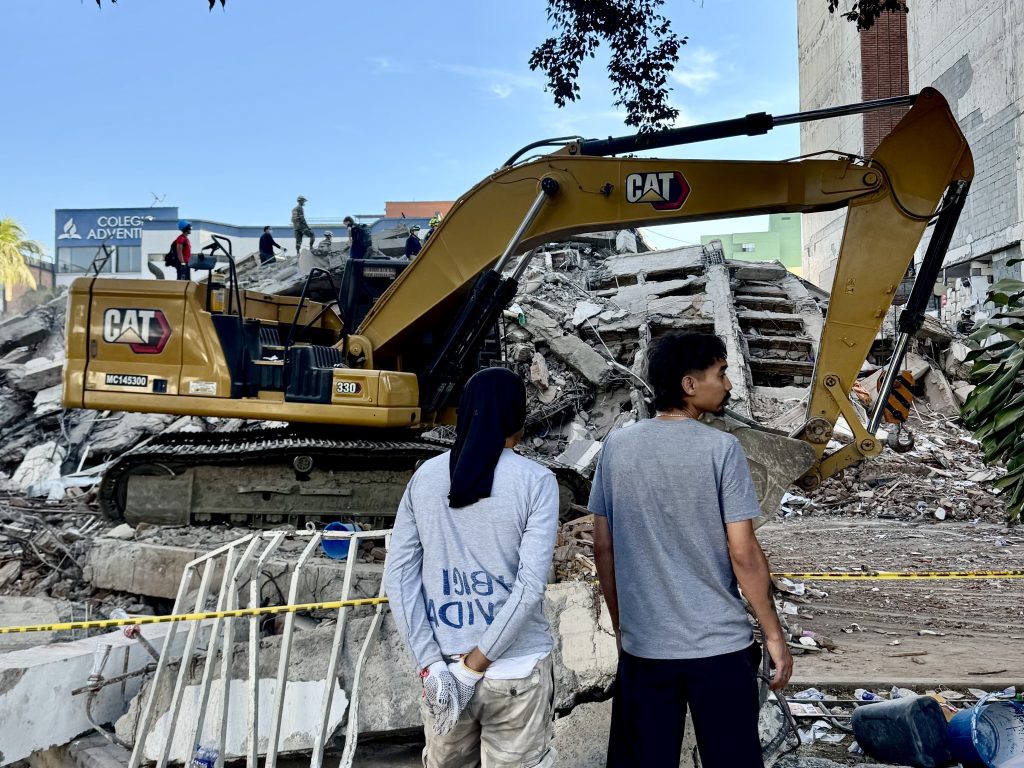
The past magnitude 7.4 earthquake, centered in the Pacific region near San José del Palmar, Chocó, caused widespread devastation across several parts of the country.
Cities including Cali, Pereira, and Manizales, alongside the department of Chocó, were among the most severely affected, with injuries, deaths, and collapsed infrastructure.
According to a government report published on September 9, the emergency left around 330 dead, more than 4,500 injured, and 16 departments affected.
Beyond the debris
After Tuesday’s tremor, renowned Colombian news anchor Rossy Lemos shared a video on social media revealing that she was going through a difficult time with her sleep and overall well-being following the tragedy that directly impacted her family and her people in Chocó.
“I haven’t been able to sleep well for almost three months. I keep waking up multiple times a night, dreaming that the ground is shaking, and I was blaming it on anything else, including stress,” she said. “It was hard for me to admit that I was terrified.”
“Today I felt it in Bogotá, and that same panic returned, because I experienced the previous one in Cali,” she added.
Lemos’ testimony highlights a broader psychological ripple effect: whether directly impacted by the devastation or not, people found themselves trapped in a continuous loop of fear.
Sara Rubiano, a clinical and legal psychologist from the University of Granada and the Université Paris Nanterre, explains that trauma is not only learned with trial and error, but also through observation.
“People, by hearing so much or having continuous contact with the suffering, terror, and traumatic experiences of others, also develop those same fear responses to those situations,” she told Latin America Reports.
For those directly affected by the past emergency, going through another quake makes the fear even more intense than the previous time, even though the situation is less dangerous.
According to the Colombian Geological Survey (SGC), the August disaster stands as the third-largest earthquake in Colombia’s recorded history, marking it as one of the most severe events of the past decade and among the strongest of the 21st century.
“Going through another tremor serves as a reminder of what happened a couple of months ago,” explained Rubiano.
“It triggers all the responses in the brain, and for these people who already experienced significant losses before, it can generate intrusive memories, flashbacks, and quite intense emotional and physiological responses.”
Collective trauma?
As the main conversation centers on shared vulnerability and a state of alert, Miguel Gutiérrez Peláez, head of the psychology program at Colombia’s Universidad del Rosario, described “a collective experience of fear and uncertainty.”
But he said the event may not constitute a collective trauma, which implies the breakdown of a community’s daily life and social connections. Though the earthquake was a historic tragedy with widespread human loss, each individual processed the experience differently.
“The fact that many people experience fear simultaneously does not mean that everyone has been traumatized. Even when facing the same catastrophe, subjective consequences vary from person to person,” the professor told Latin America Reports.
He noted that individual circumstances shape the experience of trauma.
“The intensity of the event does not, by itself, determine its psychological consequences. These also depend on each individual’s background, past experiences, and the personal resources available to respond to what happened,” the professor told Latin America Reports.
Yet, he also signaled that earthquakes have a particular ability to reach people who weren’t directly affected by them: “Earthquakes confront us with something particularly unsettling: the fragility of our existence and the impossibility of fully controlling what happens to us. Even those who did not experience the tremor directly can feel that their sense of safety has been disrupted.”
Navigating the fear
Rubiano shared some tools to work through the residual fear, noting that this feeling is a natural response that fulfills a protective function.
“Fear is not our enemy; rather, it is helping us… It precisely allows us to take action in the face of a situation,” Rubiano explained.
She also recommended recognizing the emotion and identifying catastrophic thoughts, understanding that, even when terrifying, they are not necessarily what will happen.
Rubiano also suggested other strategies like limiting news and social media consumption, sharing common spaces with other people to help regulate emotions, and maintaining basic self-care routines.
“Now, if we believe that we are already experiencing many flashback episodes, if we are experiencing many long-term difficulties sleeping and so on, well, the best thing will always be to go to a professional who can provide the necessary help on a case-by-case basis,” she concluded.