Bogotá, Colombia — In the past week, Colombians have taken to the streets on two occasions to defend the government’s minimum wage increase as it faces legal attacks by business sectors.
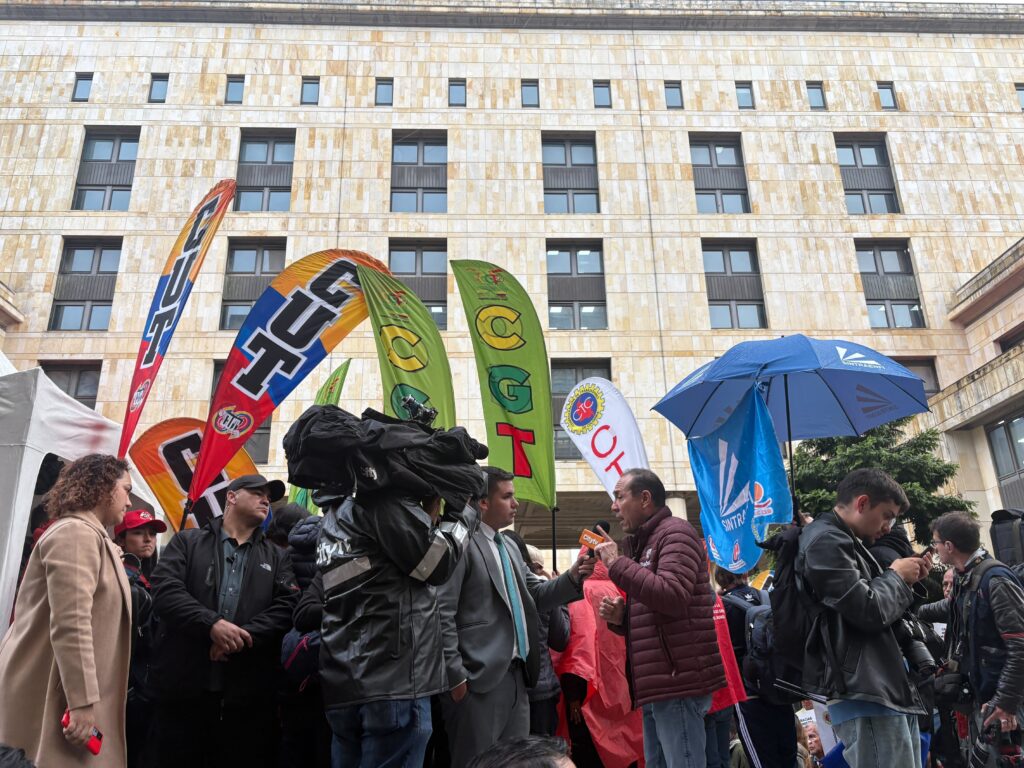
On January 28 and February 3, Colombians marched in major cities in support of the landmark 23% wage increase established at the end of last year.
But the future of Decree 1469, which established what the government has called a “living wage”, remains uncertain.
“This is a major step forward by the government of Gustavo Petro. It is not just an increase; it is the dignification of workers’ wages in Colombia. That is why, as union members and as teachers, we support this mission, which directly impacts people’s everyday lives,” Oscar Patiño, an attendee of the January 28 march, told The Bogotá Post.
For Patiño, a teacher and union leader, the protest represented a demand that the Council of State act as a guarantor of workers’ rights through its role in defining public policy.
He was part of a wave of sit-in protests in cities across the country called by labor unions, with the backing of the government, to defend the minimum wage hike. The 23% raise brings the monthly base salary to COP$1,750,905 (USD$477) and the transportation allowance to COP $249,095 (USD$68).
In Bogotá, the demonstration was joined by Labor Minister Antonio Sanguino and lawmakers from the pro-government bloc, including Senator Wilson Arias.
“This increase no longer leaves workers’ wages below key economic indicators. It is for the improvement of their quality of life,” said another attendee, who did not want to be named.
As well as raising the base salary, December’s decree incorporated the concept of a “living wage” as an additional criterion for setting the increase. This concept is not new: it is enshrined in Article 53 of Colombia’s Political Constitution and in International Labour Organization (ILO) Convention No. 131 of 1970.
“In that ruling, the Constitutional Court reminds the government that when setting wages, remuneration must be minimum, I quote, ‘living, and adjustable,’” said Mery Laura Perdomo, a lawyer specializing in labor, social security, and constitutional law.
The “living wage” responds to the real cost of living, unlike the minimum wage, which barely covers basic needs. “This helps generate conditions for a dignified life in a Social State governed by the rule of law … The major shift is from a minimum wage to a living wage,” said Labor Minister Antonio Sanguino.
The government passed the decree raising wages unilaterally after failing to reach consensus with government representatives, business associations and labor unions. It determined the base salary raise based on economic criteria such as inflation (CPI), GDP, the contribution of wages to national income, inflation targets, and productivity.
But the decree generated dissatisfaction among business associations and parts of the public, prompting them to pursue legal action.
Perdomo notes that there are two types of challenges to the wage increase: tutela actions—arguing violations of fundamental rights, specifically due process or harm to certain companies—and a lawsuit seeking the annulment of the decree.
“I believe there are no sufficient legal grounds for a potential declaration of unconstitutionality,” Perdomo said, noting that the decree grounds its constitutionality in ILO conventions, the constitution, and technical and economic studies and criteria. “There are constitutional, legal, jurisprudential, and technical-economic grounds to say that this minimum wage decree could not be declared unconstitutional.”
So far, tutela actions have not succeeded, according to Perdomo. As for the annulment lawsuit—filed by the National Federation of Merchants (Fenalco)—it is currently under review and awaiting evaluation by the assigned judge, according to the Colombian economic magazine Portafolio. The claim argues that constitutional and legal criteria were disregarded.
Portafolio also reports that the risks of the legal debate lie in the possibility that, while a final decision is pending, the Council of State could not only annul the decree but also order a provisional suspension of the wage increase.
But Perdomo warned this would be an unpopular move ahead of next month’s legislative elections: “Politically, this is risky in an electoral context, since a large portion of the population—especially low-income earners—is satisfied with the minimum wage increase. Overturning it could sour the political climate on the eve of elections and have a real impact on voting intentions.”
Meanwhile, Petro’s ruling Pacto Historico coalition, which has formed into a party ahead of the elections, has made a point of championing the minimum wage increase.
On Tuesday, it called for rallies across the country to support the living wage, justice, and labor dignity.
“The living wage is not a favor; it is a right. A dignified life begins with fair work, and this mobilization reminds us that labor dignity is the foundation of social justice,” declared Health Minister Guillermo Alfonso Jaramillo from Bogotá’s Plaza de Bolívar.