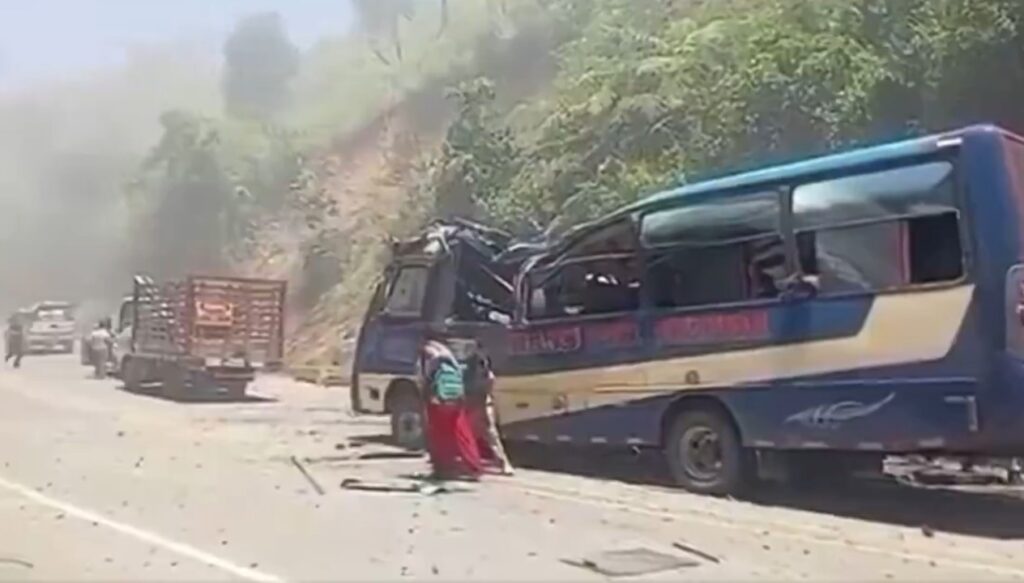
A bomb attack attributed to fighters from the EMC armed group killed 20 travelers trapped on the busy highway connecting Colombia’s southwestern cities on Saturday.
The tragic events in the El Tunel sector, close to the town of Cajibío, unfolded after the dissidents mounted a checkpoint on the main Via Panamericana south of Cali and 30 kilometers (20 miles) before Popayán.
The busy road runs through a mountainous region dominated by gangs run by the former guerrillas dedicated to a booming cocaine industry in hidden canyons beyond state control. At the illegal checkpoint the fighters forced truck drivers to block the road and abandon their vehicles, causing a long queue of traffic.
According to video posted online, soon after a midday the huge explosion rocked the valley mangling around 15 vehicles caught blockade including two minibuses with civilian passengers.
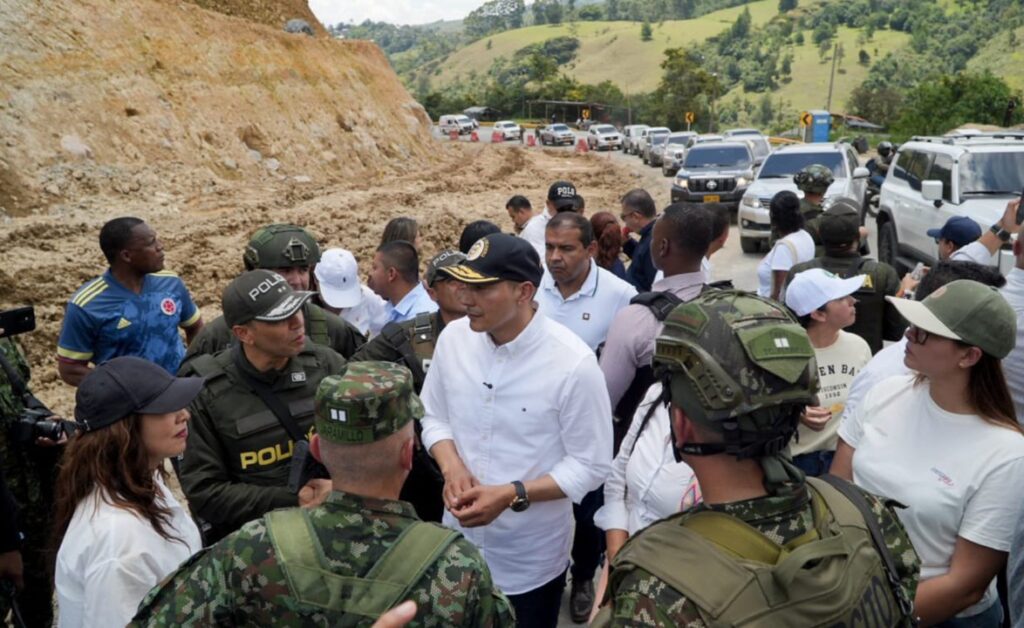
The governor of Cauca, Octavio Guzmán, confirmed the 20 dead civilians caught in the blast were 15 women and five men, all adults. A further 47 people were injured, of whom three were critical. Five children were recovering in hospital. Eleven of the affected persons came from the same village of Pedregosa, close to Cajibío, he added.
“What happened on April 25th constitutes the most brutal and ruthless attack against the civilian population in decades in the department of Cauca,” the governor later announced.
The bomb had displaced 200 cubic meters of soil, he said, creating a crater five meters deep in the Panamericana highway, the main route linking Cali to Popayan and on to Ecuador. Despite the damage, road crews were able to partially reopen the road six hours after the blast.
Saturday’s attack, one of the worst atrocities in recent years, comes against a background of rising conflict between state forces and dissident armed groups in the southwest of Colombia.
Terrorist tactics
Just in the last four days communities across three departments – Valle, Cauca and Nariño – reported a series of what appear to be coordinated attacks against civilian and military targets. These included:
- 24 April – A bus bomb exploded close to base of the Pichincha Battalion in the south of Cali, causing damage and three injuries.
- 24 April – In the nearby town of Palmira, Valle, an army base came under attack from cylinder bombs launched from a passing vehicle, no injuries were reported.
- 25 April – Two attackers launched grenades at a petrol station in Rozo, Valle, damaging vehicles.
- 25 April – A police station in the rural community of Potrerito, close to Jamundí, came under gunfire attack in the early hours of the morning.
- 25 April – In another morning attack, Aeronáutica Civil reported drones launching explosives against a hilltop air traffic station close to El Tambo (Cauca), damaging antennas and leaving the radar inoperative.
- 25 April – a chiva rural bus was hit by explosive charges while traveling on Route 25 near to Mercaderes, south of Popayan. Police reported several injured including a child but no deaths
- 26 April – four men were gunned down in a bar in Toro, Valle, between Cali and Pereira.
According to a tally by thinktank Indepaz, the Toro deaths were the 48th massacre recorded in 2026. In Colombia a ‘massacre’ is defined by the intentional killing of three or more people at the same time.
This weekend’s attacks were typical of a return to terrorist tactics such as car bombs, motorbike bombs, drones dropping home-made explosives and other artisanal artefacts.
Saturday’s Cajibío attack was initially reported as a boobytrap bomb, or “IED” (Improvised Explosive Device) which are caches of high explosives buried by the roadside by rebel groups, usually aimed at passing military patrols
But later reports suggested the civilian vehicles were struck by a pipeta mortar. These are fashioned from household gas bottles and clumsily launched from mortars made of industrial piping.
Notoriously inaccurate, a pipetas have claimed many civilian lives in the Colombian conflict, most notably in the Chocó town of Bojayá in 2002 when a charge launched by FARC guerrillas struck a church killing 79 civilians sheltering inside.
Behind Saturday’s atrocity was alias ‘Marlon’ of the Estado Mayor Central (EMC), said Colombia’s defence minister of defence Pedro Sanchez. The state offered a reward of US$140,000 for information leading to his capture.
Original dissidents
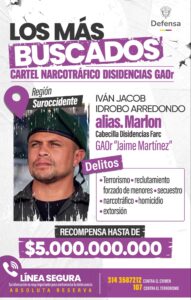
Marlon, whose real name is Iván Idrobo, was formerly in the ranks of the FARC guerrillas where he trained as a bomb maker. He is now thought to lead the EMC’s Frente Jaime Martínez which according to the Defensoria del Pueblo controls the cocaine trade, illegal gold mining and extortion rackets around the town of Suárez in the northwest of Cauca.
The EMC, lead by former FARC chief Iván Mordico, has proven to be the most intransigent of the myriad of armed groups which the current Petro government has tried to broker peace with under his controversial Paz Total policy.
See also: Peace Plan has Caused more Conflict, says Thinktank
Seen as the “original” dissidents that rejected the partly successful peace process under former president Manual Santos in 2016, the EMC initially agreed to negotiate when Gustavo Petro came to power in 2022 but soon engaged in bitter infighting with rival armed groups creating a rupture with Paz Total.
For his part, Petro tweeted his disgust at the Cajibío attack and the EMC “narco-terrorists” behind it.
“The groups led by Iván Mordisco in Cauca are criminals who have committed crimes against humanity and must be treated as such,” he said.
Some pundits commented that Petro’s early treatment of the EMC as a political actor had given the armed group room to expand, contributing to the current security crisis. In the heat of next month’s elections, others turned their ire on presidential candidate Iván Cepeda, seen as an architect of Petro’s struggling peace plans.
Rival right-wing candidate Paloma Valencia accused Cepeda of his role in “tying the hands of state forces, the rampant increase in illicit crops, the historic numbers of massacres, and waves of violence like today’s”.
Valencia also rounded on Petro for posting photos of his birthday celebrations even as the country was reeling from the horrific footage of the Cauca bombing. “Show some respect,” she messaged.