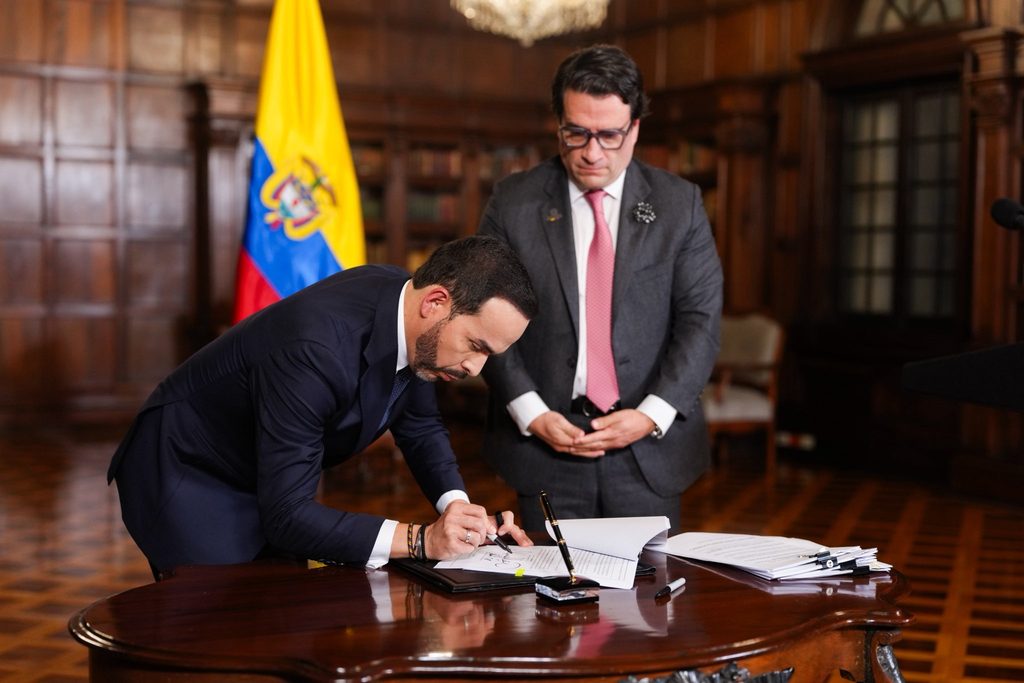
Colombian President Abelardo de la Espriella has declared an end to the country’s process of negotiating peace agreements with illegal armed groups.
In twin speeches yesterday, the newly inaugurated leader announced an end to talks with rebels, the construction of megaprisons, and the extradition of five senior rebel commanders.
The declarations mark a major step forward in de la Espriella’s pledge to launch an iron-fisted crackdown against criminality in Colombia, though analysts say much remains uncertain about the impact these policies will have.
“This government is beginning to dismantle the model of false peace and replace it with a policy based on security, the rule of law, and state authority,” said de la Espriella in a speech in Bogotá on Wednesday night.
He blasted his predecessor, Gustavo Petro, for agreeing ceasefires with armed groups under his ‘Total Peace’ policy.
“Colombia needs true peace, grounded in facts, justice, and results—not a policy that ultimately turns dialogue into a mechanism for impunity,” continued de la Espriella.
Many analysts say criminal organizations took advantage of ceasefires to rearm and recruit.
De la Espriella ran on a platform of law and order, blaming Petro for the soaring number of armed group members in recent years and the highest levels of related violence since the 2016 peace accord with the FARC rebels.
Earlier on Wednesday, the president swore in the newly appointed military leadership, who he has tasked with securitizing Colombia’s conflict zones.
“You have the historic and patriotic mission of restoring security and peace of mind to all Colombians who have been eagerly awaiting a firm response from their armed forces,” the president told members of the military at the General José María Córdova Military Cadet School in Bogotá.
Gerson Arias, conflict and peace researcher at the Ideas for Peace Foundation, a Bogotá-based think tank, said de la Espriella’s announcements mark the end of the country’s peace process.
“They ultimately shut the door on any prospect of continuing any of the Total Peace processes,” he told The Bogotá Post.
Arias noted that the process began after de la Espriella’s election in June, when many of the negotiating tables between the state and various rebel factions ended without formal conclusion.
The analyst believes that ending ‘Total Peace’ is unlikely to improve the security situation in the country and will likely increase violence in the short term.
“The groups will step up their military activities, and there will certainly be humanitarian consequences in areas where state security forces are concentrated,” said Arias.
In addition to declaring an end to peace talks, the president announced extradition orders against five senior rebel commanders.
Among them was Geovany Andrés Rojas, alias Araña, the leader of the Comandos de la Frontera (CDF), a 1000-strong rebel force based in southern Colombia near the border with Ecuador.
Araña had previously led the CDF’s peace delegation in talks with the state but was arrested in February 2025 after the U.S. issued an extradition request over his alleged involvement in drug trafficking after becoming a negotiator.
Petro approved the extradition order in 2025 but it remained suspended while Araña was engaged in peace talks. The dialogue led to the demobilization of 99 members of the CDF in June, marking one of the few victories of ‘Total Peace’.
Two more commanders are also in state custody and will be extradited to the U.S. while the other two have not yet been captured.
Arias said the five extradition orders were requested by the White House earlier this year and described them as an easy win for Abelardo.
“These extraditions were entirely predictable and are being used as political gains for the new government with minimal effort,” said the analyst.
What may be harder for de la Espriella is delivering on his agenda of bringing an end to criminality in Colombia.