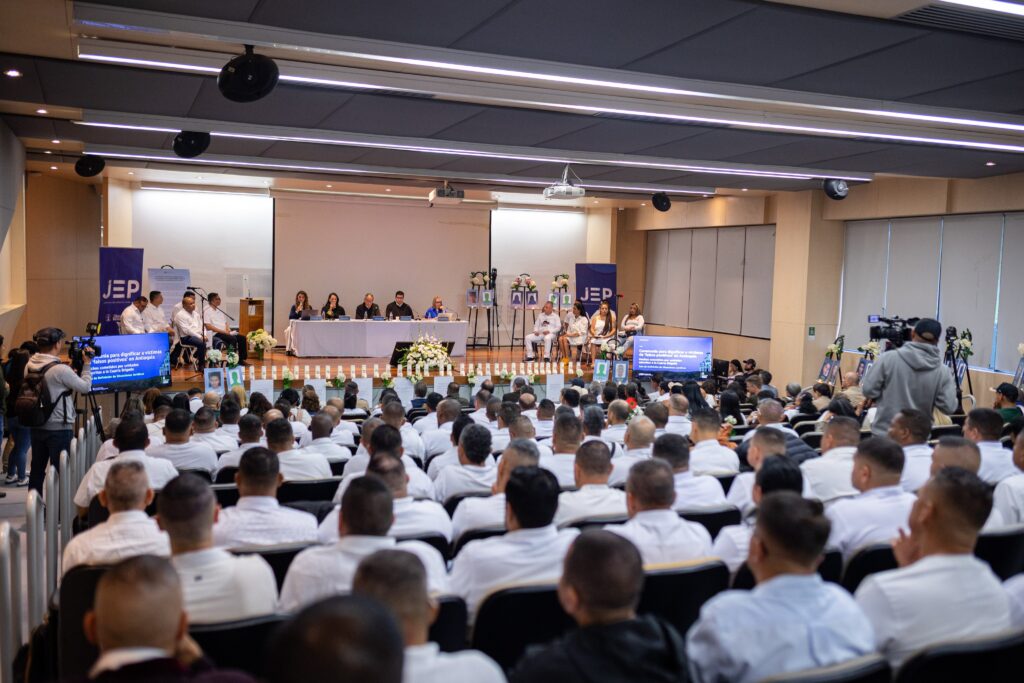
Colombia’s transitional justice mechanism, the Special Jurisdiction for Peace (JEP), announced yesterday that it had revised the official number of “false positive” killings – deaths illegitimately presented as combat casualties – from 6,402 to 7,837.
The announcement came as part of the JEP’s Macro Case 03, which is investigating extrajudicial executions between 1990 and 2016.
The country’s Truth Commission had previously established 6,402 cases of “false positive” killings but the JEP’s latest figures suggest the scale of one of the country’s largest scandals was greater than previously thought.
The information was provided by Pedro Elías Díaz on April 24, Magistrate of the Legal Situations Definition Chamber, during a hearing related to a massacre of leaders and children in San José de Apartadó, Antioquia. Díaz first revealed that 1,932 people had been killed in the department between 1990 and 2016, before disclosing the new national figure.
“The report also highlighted statistics on homicides and forced disappearances allegedly attributed to the public force between 1990 and 2016 nationwide, classified as illegitimate killings presented as combat deaths, amounting to 7,837 victims—a figure that remains dynamic as cases progress,” said Díaz.
The magistrate affirmed that in addition to the forensic identification of victims, the latest figures were based on victims’ reports submitted to the JEP since 2018 and documents from the National Center for Historical Memory, the Office of the Inspector General, and the Office of the Attorney General.
JEP President Alejandro Ramelli Arteaga later confirmed the revised figures and said that the period during which the “false positives” occurred was extended, from 2002 to 2008, to 1990 to 2016.
Ramelli added that the number is likely to increase as investigations continue: “They have been holding territorial hearings with those most responsible, who are also confessing to cases of executions and disappearances that had never been investigated. It is most likely that this new figure will continue to increase in the future.”
The “false positives”, many of which occurred during the administration of ex-President Álvaro Uribe (2002-2010) are highly politicized.
President Gustavo Petro responded to the news with thinly veiled criticism of Uribe, whose Democratic Center (CD) party won the second highest number of seats in recent congressional elections.
“There are 7,837 victims of the state due to the systematic execution of young people under the government of the so-called “Democratic Security” policy — in reality, a policy of total death… They do not want reelection for social justice; they want it for death,” wrote Petro on X.
Paloma Valencia, the CD’s presidential candidate, has pledged an iron-fisted approach to armed groups similar to that of her political mentor, Uribe, who continues to lead the party.