New rules on electric motorbikes could shift the battle of the bike lanes in Bogotá, where transit authorities are already struggling to contain the tide of battery-powered vehicles.
A law governing the burgeoning use of “VELMPUs” (Vehículos Eléctricos Livianos de Movilidad Personal Urbana), as they are officially known, is being tabled by the Ministry of Transport.
This covers the dizzying array of e-bikes, electric scooters, electric motorbikes and even motorized unicycles being deployed by commuters around the city.
The bill, which has just ended its consultation period and is expected to be signed into law in July, will impose stricter safety rules and also require registration of vehicles, though they will remain exempt from number plates, insurance or the need for licensed riders.
See also: The Battle of the Bike Lanes
Last week transport minister María Fernanda Rojas described the bill as an “historic step in personal electric mobility in Colombia”.
“We will have clear rules in terms of speed, rules such as wearing of helmets, also the infrastructure for these types of vehicles,” she said.
Legislation will also better define categories of vehicles, their power and top speed. Crucially, it also gives city transit authorities the discretion to ban specific categories of VELMPUs from cycle paths. This should end years of confusing messaging on where you can and can’t ride them.
Tiny pedals
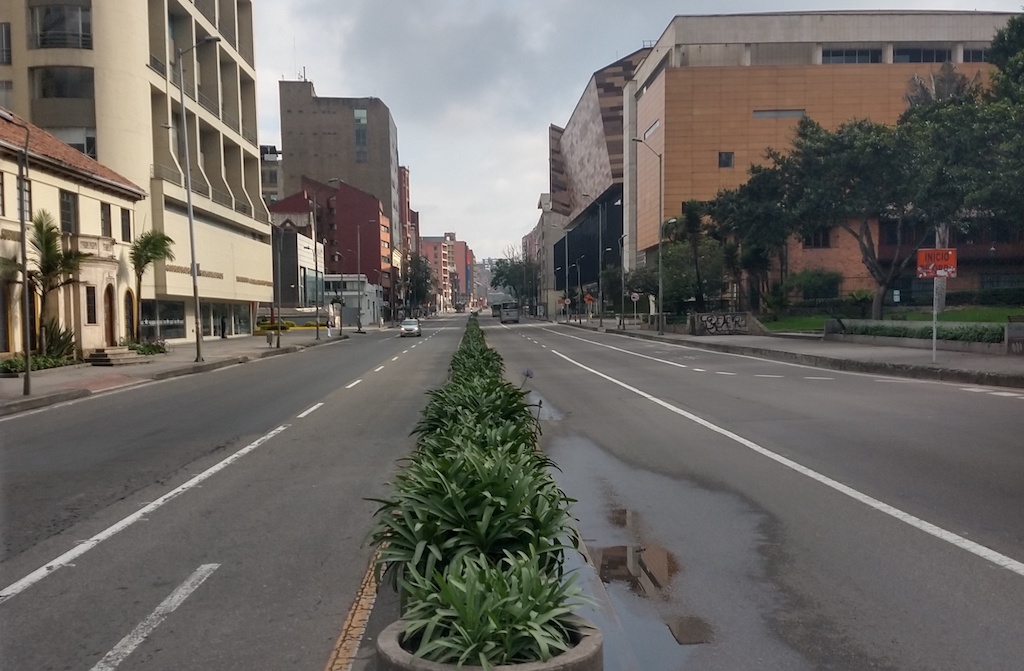
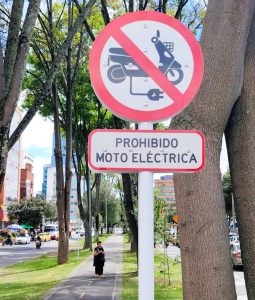
This would be a welcome development for Bogotá where the city’s 677 kilometers (420 miles) of dedicated bike lanes – the most extensive of any city in Latin America – are reserved for pedal cycles, electric scooters and e-bikes but prohibited for electric motorbikes.
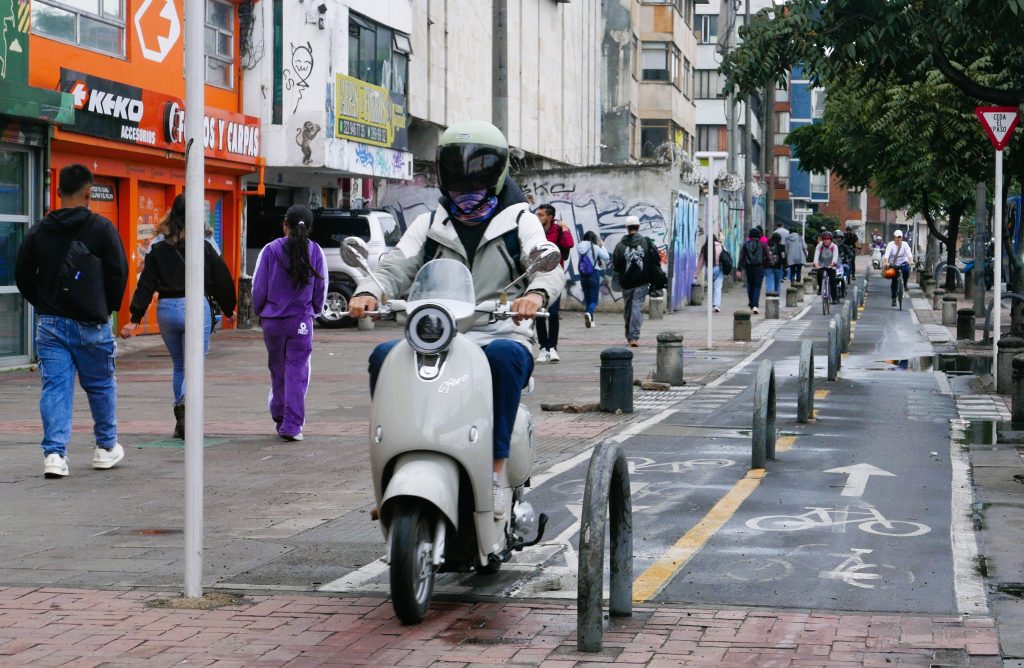
This might come as surprise to the city’s cyclists: on any given day thousands of e-motos are zipping down the ciclorutas.
In a 10-minute survey by The Bogotá Post of one of the capital’s busiest cycle routes – following the Avenida NQS – we counted 66 pedal bikes, 12 electric scooters and 38 electric motorbikes.
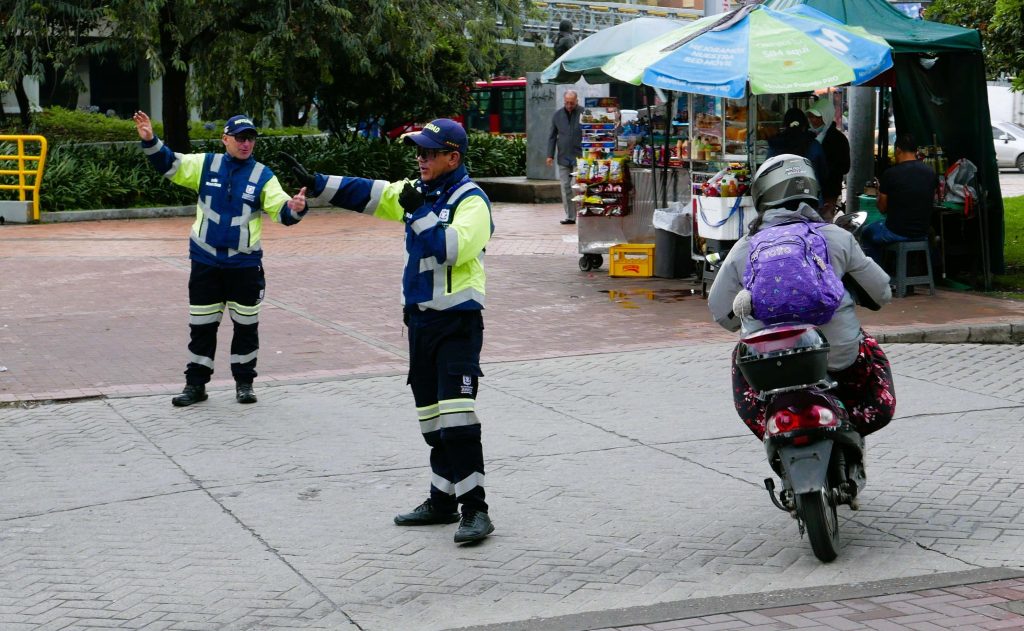
That means a third of the users were technically breaking the law, despite the on-site presence of Guias de Movilidad – council mobility guides – directing traffic around the bike lane.
“We’re not here to fine people, just to advise them,” a mobility guide Eduardo Díaz told The Bogotá Post. “People need first to be informed. Punishments will come later.”
One problem was that the businesses selling electric motorbikes were misinforming buyers, he said. The tiny pedals mounted on the rear were more for decoration and did not qualify them as a proper pedaled vehicle. “They’re fooling their customers that they are bike-lane legal,” he added.
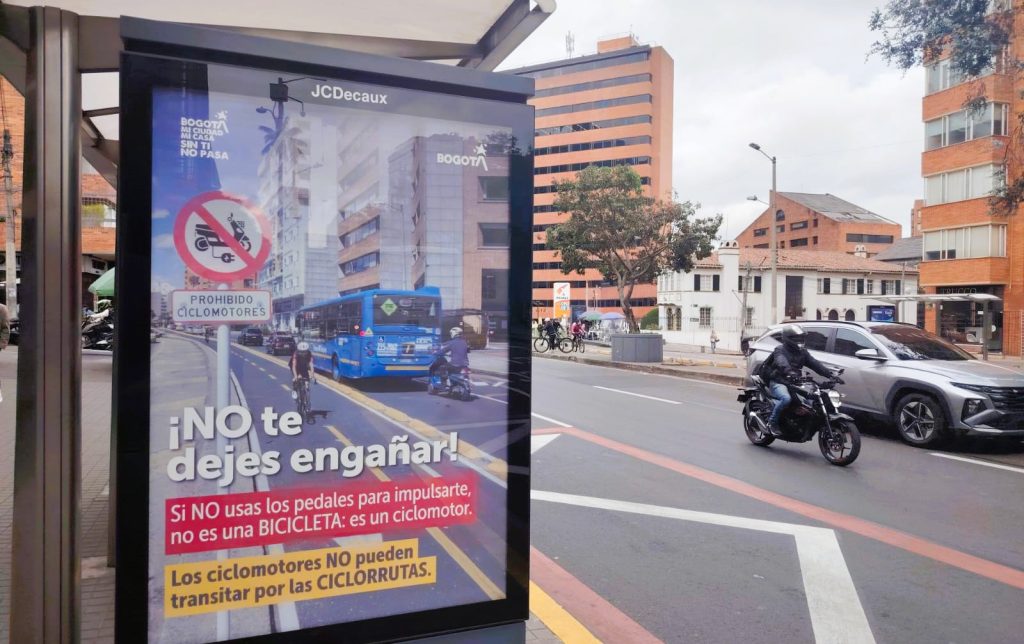
That message has been amplified by posters around the city last week saying: “Don’t let them trick you! Ciclomotores can’t use the bike lanes!”
No need for speed
The new legislation regulates several older laws on electric mobility – from 2017, 2022 and most recently Law 2486 of 2025 – which have struggled to keep pace with innovations in electric vehicle design and their capabilities.
A key improvement will be how to categorize light electric vehicles, according to Bogotá mobility expert Carlos Prado. “Before we had a terrible situation, with different interpretations of the law,” Prado told The Bogotá Post.
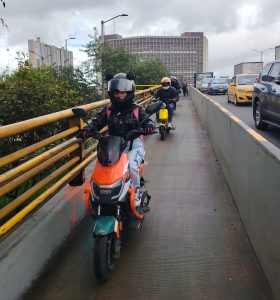
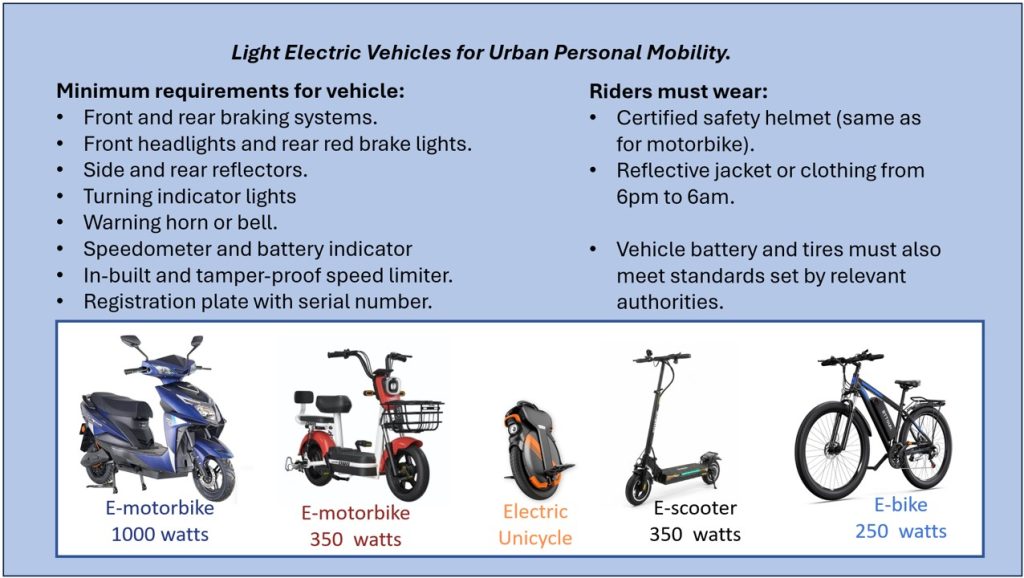
Electric motorbikes and scooters will now be defined as: “Vehicles assisted or pushed by an electric motor, of reduced weight, for individual use in urban settings, whose power does not exceed 1000 watts.”
E-bikes, or battery-assisted pedal bikes, will be limited to a maximum power of 250 watts.
The new national legislation also caps any VELMPU using a cycle lane at 25 kilometers per hour (15mph), equivalent to a fast pedal bike rider.
But Pardo is concerned that many vehicles are able to go much faster: “In an ideal world, all those devices would have a manufacturing speed limit of 25 kph.”
The legislation also requires any device sold to have a speedometer and factory-installed speed limiter within the motor.
But Pardo points out these limiters are not tamper-proof – videos are already circulating online showing users how to override these restrictions.
International attention was drawn to the dangers of high-speed crashes on cycle lanes last week after an illegal e-scooter hit a cycle on the Queensboro Bridge in New York; the Blade model scooter is advertised as reaching 80 kilometers per hour (50 mph).
Legal status
In Colombia, another initiative will oblige the owners of all electric vehicles to register them with the Registro Unico Nacional de Transporte, (RUNT), Colombia’s transport data base.
To be street legal, all VELMPUs will require a visible identification plaque showing the brand, model, year, unique registration, and maximum velocity.
This will allow transit officers and police to quickly revise and check VELMPUs, at check points for example, but also allow owners of new vehicles to be fully aware of their legal status on dedicated bike lanes, for example.
Any final say on Bogotá’s bike lanes could still be up for debate and decided by the Secretaria de Movilidad.
Right now, with its publicity blitz, the Secretaria de Movilidad seems set on protecting its pedal-bike population and the infrastructure that has won Colombia’s capital the title of second-best city to cycle in Latin America (after Niteroi, in Brazil).
Looking the other way
But then there is the problem of how to eject e-motos from the bike lanes. Currently Bogotá only has 16 bicycle-mounted transit agents dedicated to 677 kilometers of ciclorutas.
Forcing electric motorbikes onto public roads will also cause a backlash. Just in Bogotá, in 2025, some 255 motorbike riders died in crashes with 10,000 injured. Protecting cycle paths could come at a high human cost.
And on open roads, electric motorbikes will be competing with urban traffic without number plates or insurance, with no mechanical checks, and ridden by untrained and unlicensed drivers.
Perhaps surprisingly, one of the harshest criticisms of this plan comes from the motorcycle industry itself.
“We are deeply concerned about the growth of informality and illegality in the sale of electric motorcycles. They are sold as if they were simple electric bicycles, but in practice they function as motorized vehicles,” said Iván García, director of the chamber of motorcycles at ANDI, the Colombian Business Association, writing in De Moto magazine.
“The most serious issue is that they are not registered, they lack mandatory insurance, and they don’t meet any minimum safety requirements. Today, nobody knows how many there are, where they are, or where they are being driven, and this represents a growing risk to road safety and to consumers.”
In the same article, journalist and motorbike fan, Lina Posada, criticized the state for allowing electric motorbikes “to grow out of control”.
“Those who defend the right to mobility might argue that any means of transportation is valid,” she said. “But when these vehicles end up in the hands of people without training, expertise, or knowledge of the rules, the debate ceases to be about mobility and becomes about the right to life.”
The Ministry of Transport has gone some way to meet that challenge: it proposes that in future all lightweight electric vehicles will require headlamps, stop lights, turning lights, horns, and front and rear brakes. Riders will require helmets and reflective clothing after dark.
But for Posado these regulations still fall short: “We are already seeing the consequences in regions where traffic authorities are nonexistent or prefer to look the other way”.
This reflects a dilemma facing many cities across the globe: how to ride the revolutionary wave in electrical personal transport which transforms how people move across congested cities while reducing pollution. But also staying safe.