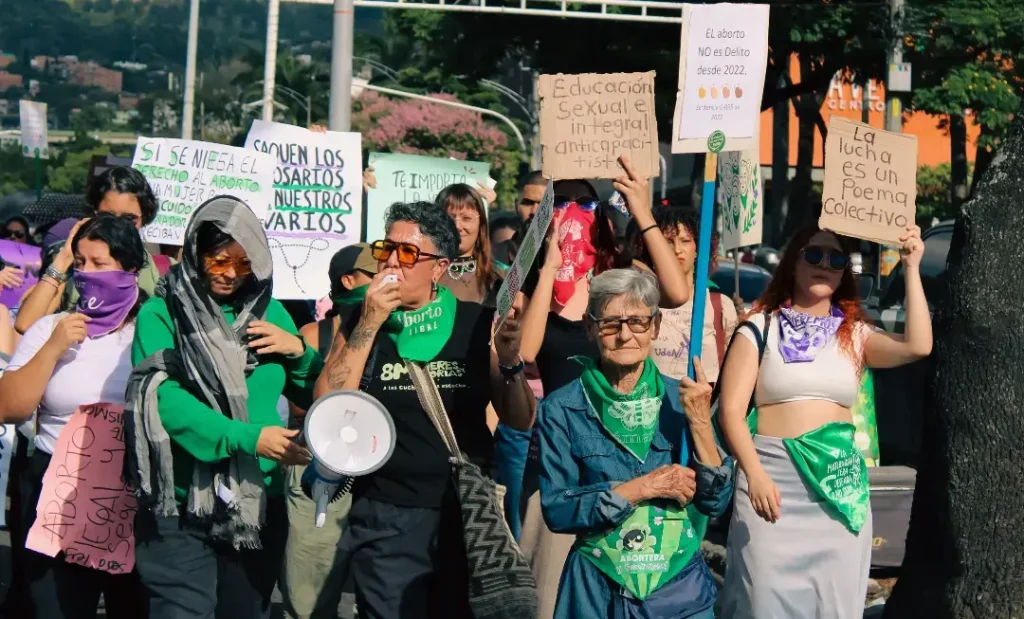
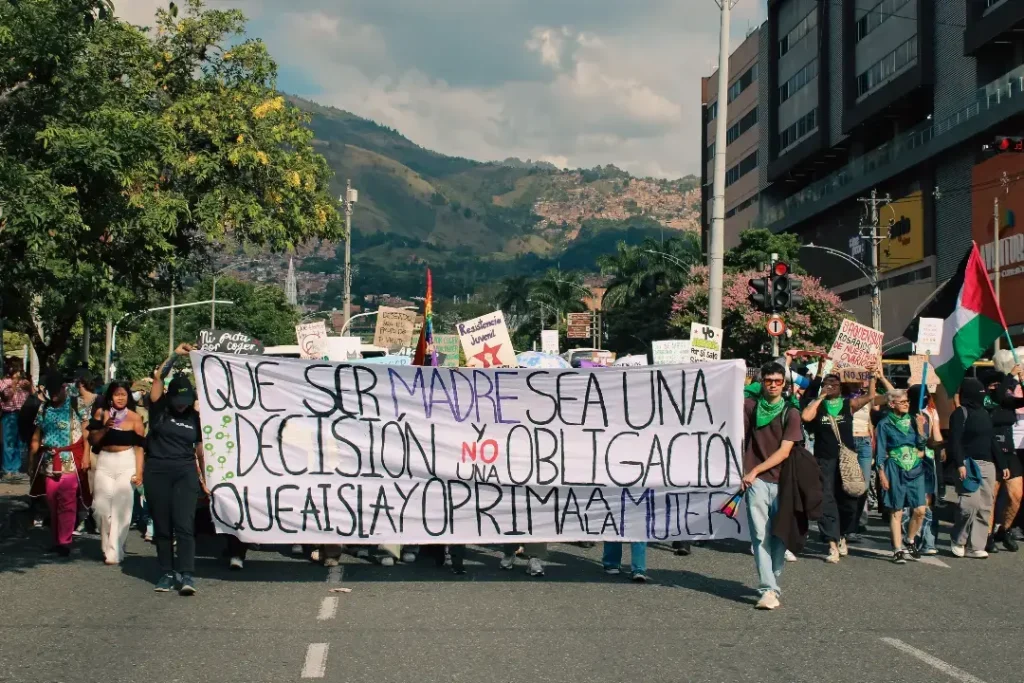
On the Global Day of Action for Access to Safe and Legal Abortion, September 28, a group of activists gathered in Colombia’s second-largest city, Medellín, to support women’s rights.
The day of action has been commemorated annually since 1990, following the Fifth Latin American and Caribbean Feminist Encuentro to demand that states decriminalize abortion and ensure effective access to safe abortion services.
In 2022, Colombia’s Constitutional Court decriminalized abortion up to 24 weeks of pregnancy through ruling C-055, following a 17-month legal process that included recusals, conflicts of interest, and a tied vote requiring an ad hoc justice to break the deadlock.
Before then, ruling C-355 of 2006 permitted abortion without a gestational limit under three circumstances: risk to the woman’s life or health, severe fetal malformation incompatible with life, or pregnancy resulting from rape, incest, or non-consensual artificial insemination.
Protesters from various rights groups in the city came out to push for continued rights and honor the women that came before them.
“I took to the streets because I believe it is essential, in the face of this neoliberal, fascist, far-right conservative advance that seeks to silence women’s voices, for women to rise up, organize, and fight for all the rights that women before us have historically fought for so that we can be here today,” Sara Ibarra, an 18-year-old activist, told The Bogotá Post.
Although abortion has been a constitutional right since 2022, Colombian women continue to face critical barriers to accessing it. Between February 2022 and February 2025, the organization Mesa por la Vida y la Salud de las Mujeres documented 1,569 such cases.
“There are really no guarantees for becoming a mother. Caring for a human being from such a young age is truly a social commitment,” said Chava, another demonstrator.
“Beyond decriminalizing abortion, it is necessary to guarantee policies that do not continue to stigmatize those who choose abortion, so that women no longer feel guilty about their decisions, and so that motherhood can truly be supported and guaranteed.”
Through 2026, Mesa por la Vida has also had to intervene in or provide legal guidance on thousands of abortion requests due to institutional barriers.
“Abortion has been criminalized for years, not only policing women’s bodies but also imposing oppression on them. The right wing does not care about or think about children; the right wing is focused on controlling our bodies,” said Ibarra.
Following the change in government, several social, human rights, and feminist organizations expressed concern about President Abelardo de la Espriella’s “anti-rights” agenda and that of his administration. The president publicly described abortion as an “abominable crime.”
“Abelardo de la Espriella has publicly declared his opposition to abortion as a health service and has stated that he would support any citizen initiative against it, thereby putting the right to health of millions of women in Colombia at risk,” the Center for Reproductive Rights said in a statement.
The organization also declared itself to be on “maximum alert” because the government’s official patform does not include initiatives related to sexual and reproductive health, contraception, safe abortion, the prevention of sexual violence against girls and women, or comprehensive sex education.
“This government has proven to be very regressive and wants to roll back many of women’s rights. Abortion is technically a relatively new right, so to speak, and it is very likely that we will have to fight to ensure that it remains protected and that this right is not taken away from us. That is why we need to protest more forcefully,” said Deyanira, one of the protesters.
At the end of July, a group of lawmakers from the political parties Salvación Nacional, the Conservative Party, and the Democratic Center—all governing-party lawmakers—introduced a bill in Congress seeking to ban abortion in Colombia by amending Article 11 of the Constitution.
The government has also faced criticism over other actions in this area, including their position against “gender ideology”, statements by the ICBF –Colombia’s child welfare institute– instructing staff not to use the word “girls” in its communications or to use only the singular form of “family.”
Read more: Colombia’s child welfare institution faces criticism for omitting the word “girl”
The director stated that there is “one type of family,” in a country where 46.4% of households are headed by women, and 69% of those female heads of household are single mothers, according to the DANE 2025 Quality of Life Survey.
“For me, it is essential that women continue to resist and that taking to the streets becomes a common practice, because we cannot continue to be afraid to raise our voices when, historically, other women have taught us that fighting for our rights is a collective struggle. Motherhood, too, must be a choice,” said Ibarra.
Featured image: On the Global Day of Action for Access to Safe and Legal Abortion, September 28, a group of activists gathered in Colombia’s second-largest city, Medellín, to support women’s rights.
Image credit: @pics_mlau