At a public school in Bosa, a locality in southwest Bogotá, a group of students are using artificial intelligence tools to investigate challenges affecting their community, from environmental problems to social concerns.
Their work is part of PorvenIA, an educational initiative developed at Colegio El Porvenir which, according to educator Lina Montenegro, took third place in the educational innovation category at the International Educational Innovation Awards, organized by the Trébol Educación Foundation in Málaga, Spain.
This project, in which approximately 120 basic secondary education students have participated, has been developed over the last three years by Montenegro and her colleague Soranlly Paola Vasco Zamudio. The initiative integrates artificial intelligence into the teaching and learning processes from a pedagogical, critical, creative, and responsible perspective.
The project is unfolding at a time when Bogotá is redefining the role that technology should play within classrooms. Less than three weeks after the Secretariat of Education publicly highlighted PorvenIA, the city issued Resolution 1037 of 2026, a regulation that limits the use of mobile phones during the school day, including breaks, in both public and private schools.
The measure, however, does not seek to eliminate technology from the classroom. The regulation permits the pedagogical use of mobile phones from the eighth grade onward, provided there is a clearly defined activity with specific learning objectives, carried out under the guidance of a teacher.
It also establishes progressive limits on the use of other types of screens, based on the students’ age; activities specifically related to Technology and Informatics, however, are exempt from these limits.
This distinction presents teachers with a more complex challenge than simply deciding whether to allow or prohibit devices: how to integrate tools like artificial intelligence into the learning process without them becoming a source of distraction or dependency, while simultaneously teaching students to use them in a critical and responsible manner.
In Bogotá, projects like PorvenIA illustrate one of the ways in which some educators are attempting to strike that balance.
From passive screen use to active learning
For Montenegro, a mathematics and computer science teacher at Colegio El Porvenir, the objective of PorvenIA is not simply to familiarize students with new technologies, but to teach them how to use them as tools to develop their own ideas.
In computer science classes, students use generative AI to create videos, infographics, stories, comics, and programs. However, each activity is based on a defined educational purpose and is carried out under the supervision of teachers.
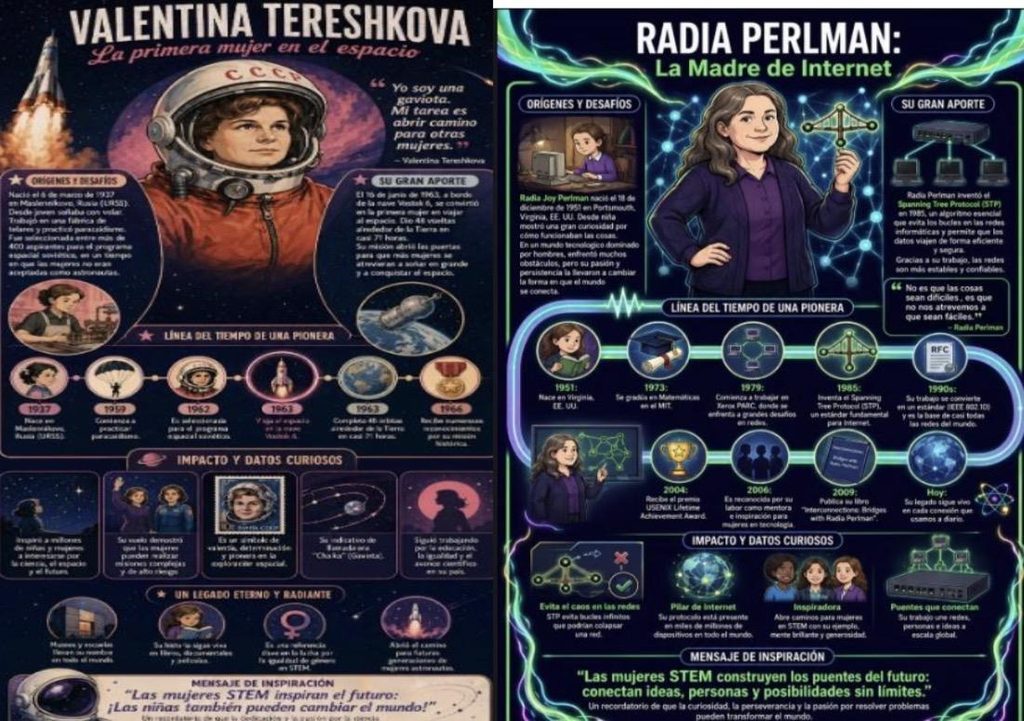
One of the projects, titled “Pollution Monsters,” involves designing creatures that represent different forms of environmental pollution. With the help of AI, students create images and develop the characteristics of each character including their strengths, vulnerabilities, and the pollutants that fuel them. Afterward, they use this material to develop a board game focused on environmental care.
In another activity, students use Teachable Machine, a tool for training machine learning models, to classify ferrous and non-ferrous materials. During this process, they observe how data influences the results and why systems can make errors when provided with insufficient information.
According to Montenegro, these experiences have enabled students to move from being passive users of screens to gaining a better understanding of how the technologies they use work.
The teacher also points out that the project seeks to preserve students’ creativity and autonomy, preventing artificial intelligence from replacing their ability to research, analyze, and express their own ideas.
The risk of letting AI do the thinking
However, incorporating artificial intelligence into classrooms also raises questions about how much of the intellectual work continues to be performed by a student.
Andrés Chiappe, a professor at the Universidad de La Sabana and director of the doctoral program in Educational Innovation using ICT, warns about what he calls “excessive cognitive delegation” – situations in which students allow artificial intelligence to carry out reasoning processes that they ought to develop themselves.
For Chiappe, one of the main risks arises when a student submits a response generated by artificial intelligence without having participated significantly in its creation. Under such circumstances, a completed assignment does not necessarily demonstrate that learning has taken place.
The researcher believes the difference lies in how the activities are designed. For example, a student could first construct their own argument, then compare it with an AI-generated response, and explain which elements they would keep or modify.
In this way, technology can serve as an aid to reasoning rather than a replacement for it.
Chiappe also draws a distinction between using these tools frequently and becoming dependent on them. While some students turn to AI to cross-check ideas or grasp concepts, others might use it to avoid the effort of reading, analyzing, or solving problems.
For this reason, he argues that the educational discussion should focus not only on the extent to which technology is used, but also on when it is used, for what purposes, and under what conditions.
Can AI education coexist with phone restrictions?
This distinction takes on particular importance in light of Bogotá’s new regulations.
Montenegro explains that PorvenIA’s activities are carried out primarily on computers, using artificial intelligence tools available online. Mobile phones are rarely necessary, and when they are used, it is for a specific task.
Resolution 1037 enables the pedagogical use of mobile phones starting from the eighth grade, provided there is a clear academic objective and teacher supervision. It also establishes specific limits for other screen-based devices, varying by student age, with exceptions for Technology and Computer Science classes.
In Chiappe’s view, restricting mobile phones and expanding the teaching of artificial intelligence are not incompatible goals. He believes that educational institutions can determine the appropriate times, conditions, and devices for each activity.
However, he cautions that restrictions alone do not resolve the educational challenges related to technology. It is also necessary to examine whether school activities offer meaningful experiences that sustain students’ interest and engagement.
At Colegio El Porvenir, “PorvenIA” represents an approach to this challenge: using artificial intelligence to develop specific projects, without turning it into a substitute for intellectual work.
As Bogotá moves forward with the implementation of its new restrictions, experiences like this one raise a broader question for schools: not just when students should use technology, but what they should be learning while doing so.