Medellín, Colombia – Prominent female journalists, writers, academics and columnists in Colombia have drafted and signed a declaration titled ‘No to the pact of silence’ in response to former president Andrés Pastrana’s appearance in the Jeffrey Epstein files.
Andrés Pastrana (1998-2002) was mentioned 57 times in files linked to Epstein, who was convicted for sexual trafficking and exploitation of minors before his death in 2019. The ex-president appeared in the batch of documents released last November by the U.S. Justice Department.
The declaration called on Pastrana to issue a statement as a matter of public interest, posed 20 questions to the ex-president, and demanded urgent measures to protect women and girls in Colombia.
‘No to the pact of silence’
The Epstein files have caused scandal across the world, implicating some of the world’s richest and most powerful people, including names like Bill Clinton and Andrew Mountbatten-Windsor.
Epstein and his partner, Ghislaine Maxwell, were both convicted for their involvement in the sex trafficking network. Epstein was found dead in 2019 in his prison cell in New York and Maxwell has been in prison since 2022.
In Colombia, the release last November of 3 million additional files linked to investigations into Epstein revealed connections between Pastrana and the late billionaire.
These included: a photo of Pastrana and Maxwell wearing Colombian Air Force uniforms at a military base; compromising emails with Maxwell; testimonies in which Maxwell said the two were friends and that she flew a Black Hawk helicopter in Colombia; and an alleged flight on a private plane with Epstein and disgraced modelling agent Jean Luc Brunel, who was accused of procuring minors for the late financier.
The ‘No to the pact of silence’ declaration was conceived mostly by female journalists while they were investigating Pastrana’s involvement in the files.
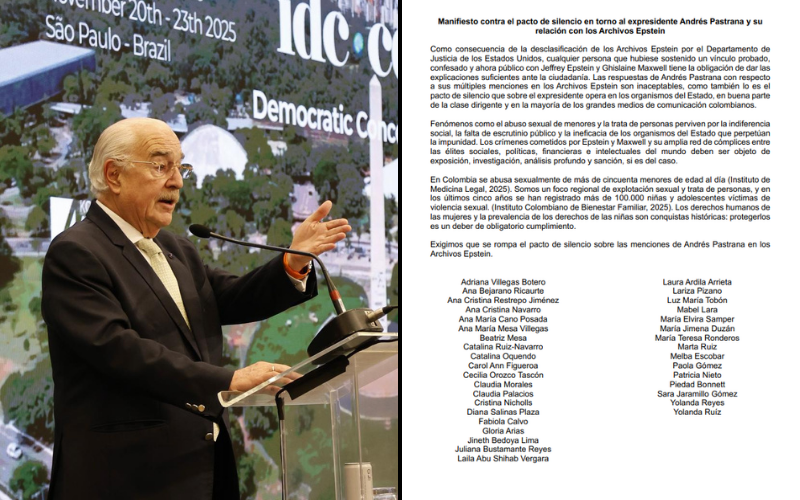
The statement was published on February 24, signed by 35 women, but has since been opened up to include other women through one-to-one invitations.
“The crimes committed by Epstein and Maxwell, and their extensive network of accomplices among the world’s social, political, financial, and intellectual elites, must be subject to exposure, investigation, thorough analysis, and, if applicable sanctions,” the declaration stated.
Colombian journalist Ana Cristina Restrepo, one of the creators and signatories of the declaration, spoke to The Bogotá Post about the reasons behind it.
“It is of public interest in several aspects. First, because he is a person who was elected by popular vote. He was a President of the Republic, and with greater responsibility comes greater scrutiny from citizens,” said Restrepo.
Currently, the declaration has 171 signatures that meet three requirements: to be a woman, to be a feminist, and to have a public voice. Signatures must also be made in individual names, not on behalf of collectives.
While there were men that showed support and wanted to sign the statement, Restrepo explained that only women were allowed: “Many thanks, but they – men – can write their own declaration. Why didn’t they think of it before?” “It has a symbolic power that we are all women,” she added.
The statement also took aim at the wider issue of sexual violence in Colombia. It highlighted that more than 50 minors are abused per day, according to the Institute of Legal Medicine in 2025. Also, in the last five years more than 100,000 girls and adolescents were victims of sexual abuse, according to the Colombian Family Welfare Institute (ICBF).
“Women’s human rights and the primacy of girls’ rights are historic achievements: protecting them is a mandatory duty. We demand that the silence surrounding the mentions of Andrés Pastrana in the Epstein files be broken,” the declaration stated.
Restrepo said that the pact of silence their statement seeks to redress is “one arm of something bigger”: a patriarchal pact that has existed for centuries.
“It is a tacit pact among men who hold power and belong to the elites to protect one another in the different things they do – not only sexual crimes, but also, let’s say, economic matters,and issues in society. They cover for each other,” she explained.
20 questions after more than 20 years of silence
In addition to calling for an end to the pact of silence, the declaration posed 20 questions to Pastrana. These were drafted based on the Epstein files, but also with other evidence, following a methodological journalistic investigation by Restrepo, Diana Salinas and the Cuestión Pública team, Daniel Coronell and Ana Bejarano.
“Everything is based on published and known facts, not on assumptions,” Restrepo explained.
Each question has a lengthy preamble that contains corroborated evidence including pictures, email threads, timelines, interviews, and testimonies. All questions have to do with Pastrana’s relationship with Epstein and Maxwell, their meetings, mentions in the list, contradictions in his statements and related matters.
“Asking questions is not incrimination,” she said. “We are saying: If he has nothing to hide, then answer.”
The enduring pact of silence
Since the declaration was released, many prominent figures have come to Pastrana’s defense.
Following its publication, Pastrana’s former ministers and others who were part of his administration issued a statement of solidarity with the ex-president: “We know Andrés Pastrana and we worked with him as part of his administration… He is a good man of strong values, respectful of his family and human dignity. His character and his track record do not correspond to being involved in infamous conduct,” the statement said.
The signatories have also faced verbal attacks since the declaration was published, including from public figures. One of the primary sources of the abuse has been the former president’s brother, Juan Carlos Pastrana, with Restrepo saying, “he has been one of the most violent.”
For Restrepo, this reaction highlights the very problem the declaration seeks to redress – that powerful men protect their own.
She also noted that the so-called ‘pact of silence’ extends far beyond Colombia.
“The U.S. Department of Justice releases the Epstein files. In other words, they already knew this information and had it stored… There are files from 2003; there are files that are more than 20 years old,” said Restrepo.
“How do you manage to keep information about a network involved in trafficking and sexual exploitation of minors for more than 20 years if not through a pact of silence? So it is a pact of silence that exists not only in Colombia, but also among elites around the world,” she concluded.
Featured image description: Split image of former President Andres Pastrana and the initial declaration signed by 35 women.
Featured image credit: @AndresPastrana_ via X.