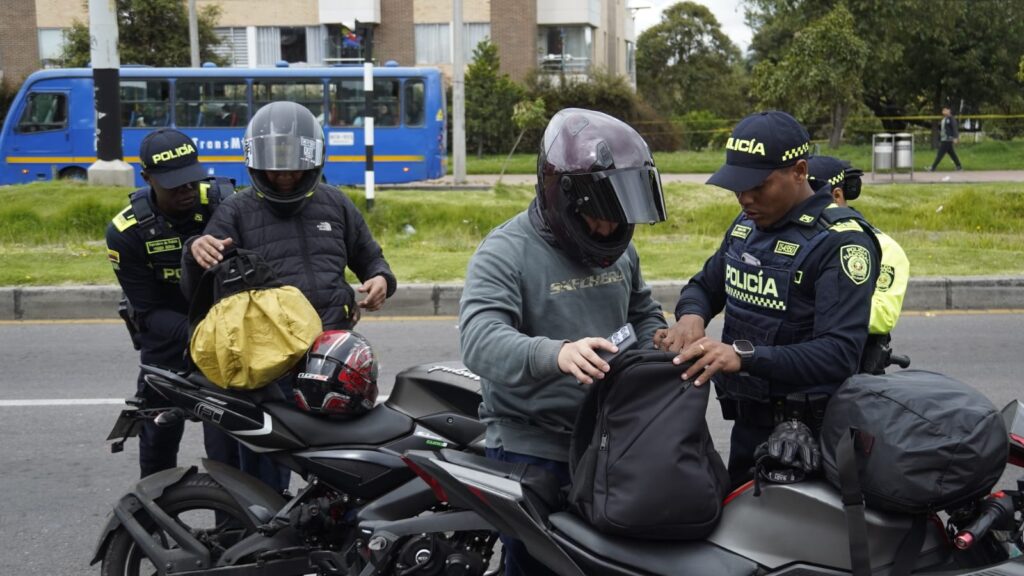
Bogotá’s mayor and security chiefs celebrated some positive results last week with stats showing an overall reduction of high-impact crimes in the city during 2025, with the murder rate dropping in the city even as violent deaths increased across Colombia.
“In Bogotá in 2025, there were fewer homicides robberies, fewer vehicle thefts, fewer motorcycle thefts, fewer cases of extortion, more drug seizures, more weapons seizures, and more arrests,” said Bogotá´s mayor Carlos Galán, presenting a security scorecard showing security shifts in the first two years of his administration.
Some decreases were significant, such as extortion cases dropping by 20 per cent, stolen car cases by 22 per cent and commercial theft by 30 per cent. Others were less impressive: street robberies only reduced by 6 per cent, and cases of sexual violence by 8 per cent.
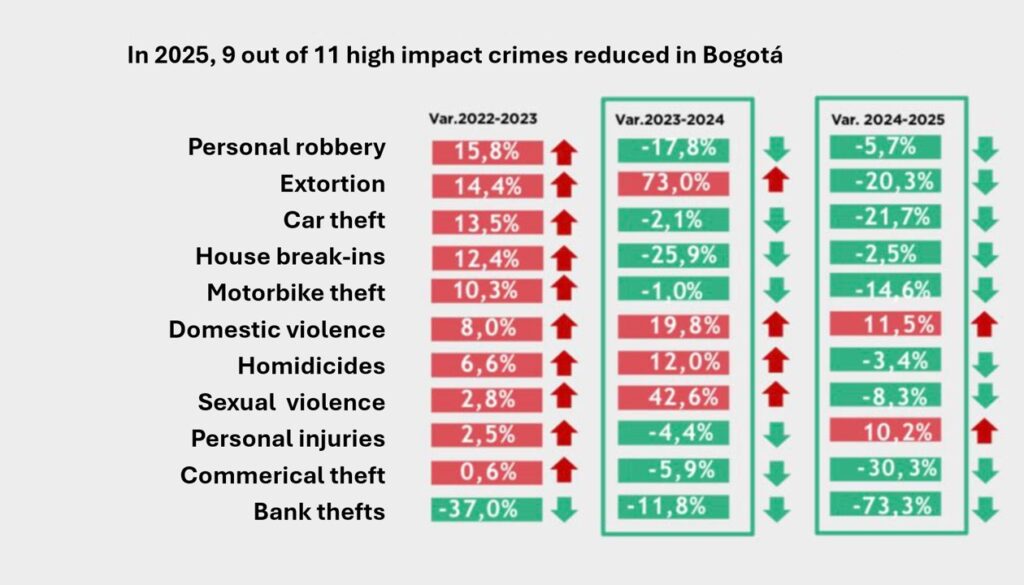
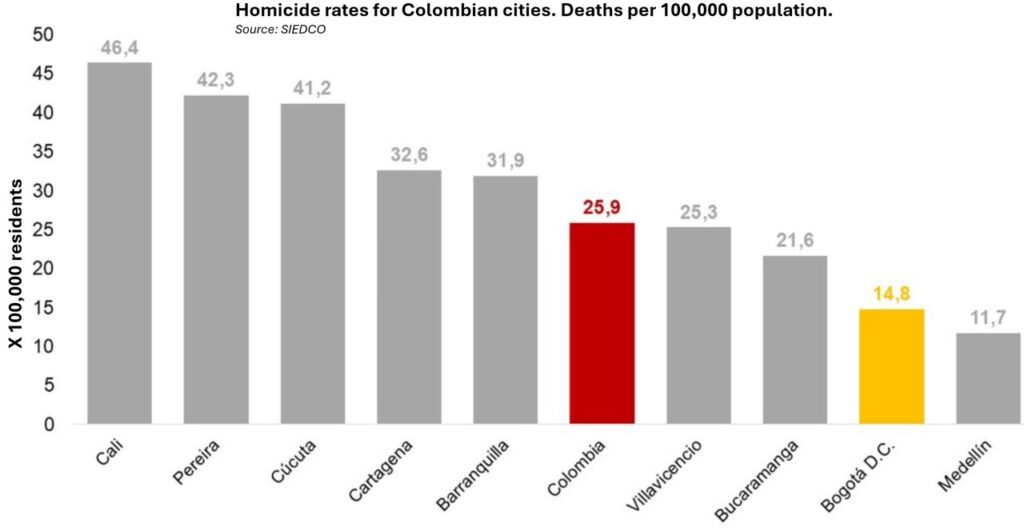
Homicides, perhaps the most significant metric, reduced last year by just 3.4%, with 1,165 killings recorded on the national police database compared to 1,214 in 2024. This gave Bogotá – with a population of around 8 million – a current homicide rate of 14.8 deaths per 100,000 of the population, according to the standard formula used to compare deaths across varying population sizes.
Limited success
This was way short of Mayor Galán’s stated goal of 8 deaths per 100,000 during his four-year tenure, but a better result than the national one. At 14.8, Bogotá’s homicide rate was considerably lower than Colombia’s national figure of 25.9 deaths per 100,000 of the population, based the alarming total of 12,484 violent deaths reported nationwide – a two per cent increase on the previous year.
City security secretary César Restrepo also pointed out that Bogotá had proportionally less murders than other major cities such as Bucaramanga, Cartagena, Barranquilla, Pereira and Cali (see table below). Medellín, however, bested the capital with a reduced rate of 11.7 per 100,000.
And in our own comparison with cities worldwide, Bogotá’s homicide rate was lower than Washington D.C. (17 per 100,000) Baltimore (23 per 100,000) or New Orleans (33 per 100,000) but much higher than most European cities such as London (currently at 1 per 100,000) or Berlin (3 per 100,000).
Backdrop of violence
The challenges facing Bogotá in reducing violence against a national backdrop of increasing insecurity were highlighted in a recent study by think tank Centro de Paz y Seguridad Externadista which compared homicides rates between recent national governments.
The current Petro government reported 40,633 violent deaths during its first three years, an increase of 11 per cent over the same period for the Juan Manuel Santos government (2014 to 18) and seven per cent higher than during Ivan Duque’s tenure from 2018 to 2022.
The data pointed to a failure of the Petro’s Paz Total (‘Total Peace’) process which reduced military pressure on illegal armed groups allowing them to expand their range and illegal activities in the last three years, concluded the report.
“Although the government insists that the national conflict is de-escalating, the figures point to another scenario: homicidal violence remains at high levels,” said study leader Andrés González in December presenting the findings on YouTube.
González also pointed out that while most territorial battles took place in rural areas, the effects reflected in urban hubs where local crime groups – often with links to larger armed groups – used lethal violence in conflicts linked to extortion and micro trafficking.
Catch and release
Another challenge for Bogotá’s security was the low conviction rate for captured criminals, according to city police chief Giovanni Cristancho in an interview with El Tiempo. Out of 33,000 criminals arrested in the city in 2025, less than 10 per cent ended up in jail, he said.
Criminals showed little fear of the justice system, and many caught by the police were multiple offenders, said Christancho, with the police having to “catch the same person 20 times”.
Recycling criminals back on the streets was “outside the control of the district government”, security chief Restrepoalso told El Tiempo last week, but recognised it reflected badly on the city administration.
“Most citizens express their annoyance because criminals are either released or not convicted. As long as these other conditions remain unresolved, all the results we announce will continue to generate frustration among the public,” he said
This chimed with a common perception in Bogotá that even if the police are clamping down, the justice system as a whole is failing the city. Those concerns were echoed in a recent public survey by city watchdog Bogotá Como Vamos that found that a 62% of respondents perceived Bogotá as less secure, the highest figure recorded since 2008.
Catch and kill
Low conviction rates could explain the resurgence of vigilante justice being meted out by frustrated rolos in recent years, with groups of citizens organizing to capture and beat offenders, sometimes tying them to lampposts or parading them naked through neighborhood and posting videos on social media.
Barrio justice has long been a problem in Bogotá; a study from 2016, reported in The Bogotá Post, showed an average of one lynching death every three days over a 12 month period in the city.
A more recent phenomenon in the city is the rise of fleets of armed private security guards mounted on motorbikes chasing down stolen vehicles.
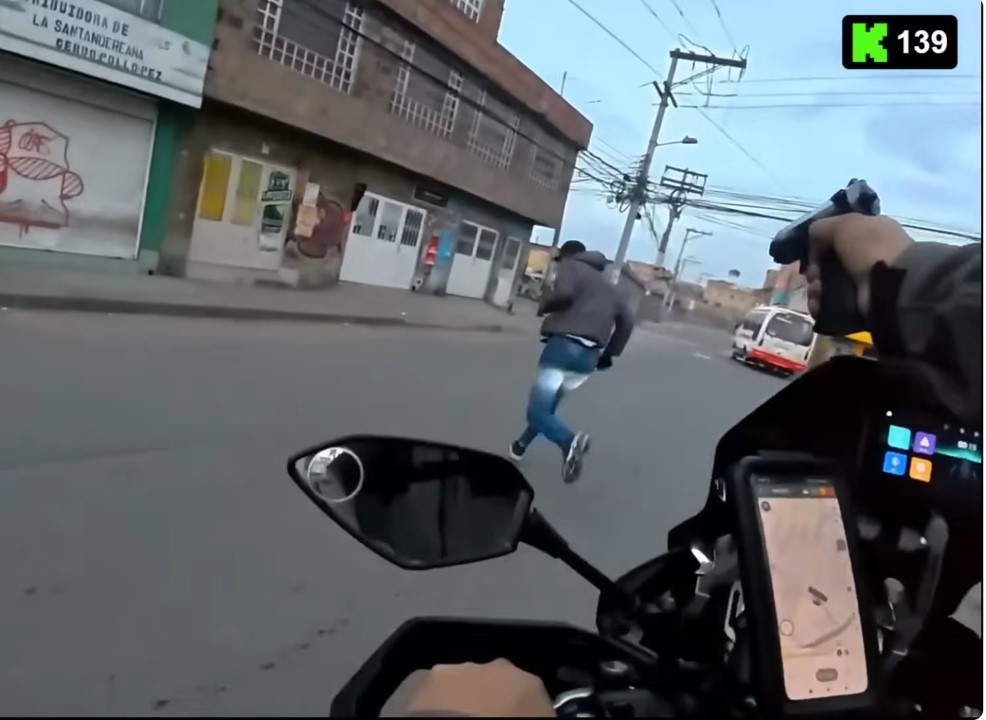
One company, Self Security GPS, uses satellite tracking and immobilizer devices to recover stolen vehicles, but also regularly posts alarming videos of their ‘commandos’ taking down car thieves, sometimes with dramatic shoot-outs on the street with passers-by diving for cover.
According to data from the mayor’s office, at the last count, there were 150,000 private security guards “supporting security in Bogotá” – far outnumbering the 17,500 uniformed police.
Increasingly though, frustration among everyday citizens has boiled over into drastic reactions to street crime. Such an attempt at instant justice ended in tragedy last week with three deaths after a Bogotá driver was robbed at gunpoint by two masked robbers on a motorbike; the victim gave chase and crushed the fleeing assailants with his pick-up truck. In the ensuing multi-vehicle crash one of the robbers was killed, along with two innocent travelers who also lost their lives.
Statistically, not a good start to 2026.