Confused about the upcoming Colombian presidential election? We’re here to help you with a set of cheat sheets on the top candidates so you can follow the local news. Today we’re looking at poll leader Iván Cepeda of the Pacto Histórico.
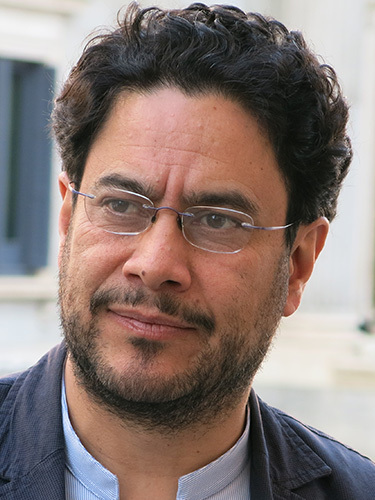
Who is Iván Cepeda?
Iván Cepeda Castro is a leftist politician who has served in the Colombian senate for the last 12 years. Before that, he was a Congressman for a term. Born in Bogotá to activist politician parents, the family was forced into exile in Soviet Czechia and Cuba in his youth. At 63 years of age, he’s notably older than his main rivals.
His father was assassinated for political reasons in 1994, something that has unsurprisingly contributed enormously to his sociopolitical views. He was a young communist, but long since moved away from that, preferring to concentrate on social analysis, activism and campaigning against rightist corruption.
He represents the Pacto Histórico ruling coalition, meaning that he benefits from the popularity of the current president Gustavo Petro. That’s no surprise, as they’ve been firm friends and comrades for years, with the president supporting his bid.
In comparison to his mentor, Cepeda is far more serious. Petro often plays the cuddly socialist grandpa, going off on tangents about free love and so forth. Cepeda is much more of a hardline Maoist academic who is well up for a long march through the institutions. He lacks the charisma of Petro, coming across more professorial and dry.
Is he polling well?
Very. He’s absolutely nailed on for the second round, with the only real question being how high his vote share is. There is some speculation that he may come second, but more likely he will be comfortably in front of the two rightest candidates.
The trickier part is the second round, when the right will be consolidated behind one person rather than split in two. He’s still often favourite against both Abelardo de la Espriella and Paloma Valencia, but likely prefers the former.
While he’s been out in front all through the campaigning process, he’s not really gone anywhere, simply sitting on 38-43% in every poll. While that’s admirable consistency, it also calls into question his ability to draw in the undecided voters.
He’s a marmite candidate, with very few informed voters neutral on him. Either you think he’s the saviour of the republic who can make Colombia more equal or you think he’s a dangerous revolutionary who will ruin the country. A lot of votes are for him under any circumstance and as many are against him under any circumstance.
What’s his campaign like?
Firmly leftist, unsurprisingly. He’s also leaning heavily into being the continuity candidate for the Petro government. That makes sense, with approval levels riding high after the giant minimum wage increase this year. While that might yet be a problem down the line, it’s electoral dynamite.
However, his campaigning has been rather lacklustre. He’s not a natural orator in the way that Petro is, and he lacks charisma, coming across as a dry theoretical academic. Perhaps aware of this, his team have arranged rallies where he can preach to the converted and otherwise keeping him out of the spotlight.
In reality, much of his campaigning is being done by others. Petro is the key figure here, with the president right up against the line of not technically campaigning. However, the head of state is taking a lot of actions that are clearly designed to help Cepeda, as well as constantly using his pulpit to call for the continuation of his ideas.
Complementing this is an incredibly powerful influencer/social push. Much of this is fairly organic, with Pacto supporters used to activism and intuitively good at promoting their candidate. It fits in well with his man of the people image. The biggest meme is ‘Solo pacto en esta mondá’. Notably, Cepeda himself isn’t the draw, with variations on the phrase namechecking Petro.
Combined with his very loose manifesto (see below), his campaign messaging is basically that only the Pacto will stand up for the people, especially those that have been treated poorly by the state. There’s little in the way of concrete offers, just a call for loyalty.
So what’s in his manifesto then?
You can read it for yourself online, but have a big pot of tea ready: it outdoes Marx and Engels at a whopping 433(!) pages long. A lot of that is AI images, while the actual propuestas are hidden away between rambling discourse, tangential essays, theoretical musings and diary entries. Notably, it is mostly in the past and present tenses.
A recurring theme is the involvement of civil society via what he calls the poder constituyente, especially youth and women’s groups. He claims he will call all political and social actors to the table in a mesa de diálogo nacional aimed at forming concrete proposals.
This will be implemented by a new Alianza Público-Popular which will allow civil groups to directly manage state funds. Both ethnic minority and campesino territories will be recognised and organised. There will be a Banco del Pueblo to improve access to financial instruments for poorer people as well as the unbanked.
Security is not a priority, but the key aim is to dismantle armed groups that are ‘successors of paramilitaries’. Iván Cepeda will continue the extant peace talks set up by Petro, but with a red line over assassinations of social leaders. Coca farmers will be encouraged to turn away from illegality via crop substitution.
Corruption will be dealt with by the Secretary for Transparency of the Presidency being given full independence and the Fiscalía receiving an Institute for Macrocorruption, as well as beefing up existing systems. Civil society will be encouraged to involve themselves in these processes.
A new Ley de Austeridad Republicana will be brought in to limit state spending via civil servants in an attempt to cut costs. He will reduce the salaries of the president’s office immediately and encourage his ministers to do the same. There will be greater scrutiny of public spending across all levels of the state. Again, no details.
More interesting is the promise to give victims of corruption resources, partially funded by seizure of illegal gains. All of this will be aimed at the parts of the country with the highest rates of corruption and impunity.
Victims of the conflict, meanwhile, will benefit from a new acuerdo nacional which will aim to deliver further reparations. He will also make sure that the 2016 peace agreement is carried out as originally planned, focusing on the Planes de Desarollo con Enfoque Territorial (PDET) for the areas most affected.
International relations will not revolve around the interests of Washington or Miami (?), but rather the national interest. The plan is for autonomy and integration, again involving civil society to work with foreign-based counterparts.
For rural areas, there will be 30,000km of minor roads built to improve connections to far-flung places, known as the vías para la paz. There will also be more rights to participate in politics, defend territory, improve connectivity and services, more land restitution and so on, none of which is clearly defined or detailed in numbers.
Rubbish is on the agenda, unlike any other candidate. He promises to strengthen and enforce recycling schemes and the basura cero initiative. Revitalisation and regrowth of urban areas is also under plan. On transport, he says he will rejuvenate trains as well as sort out the roads.
Who is he running with?
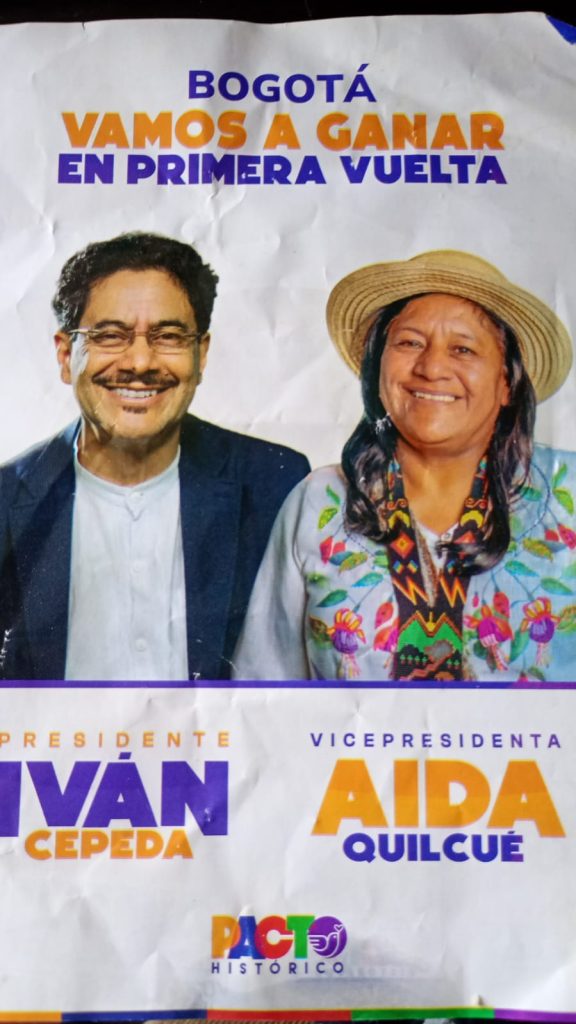
Aida Marina Quilcué Vivas is an Indigenous activist and current senator of the Republic. While she won’t bring any votes with her, this is a huge signal from the Pacto that they are serious about Indigenous representation.
Her selection shows Pacto confidence that they don’t need to reach out and form alliances with other groups. The advantage is that Quilcué and Cepeda will agree on virtually everything, in sharp contrast to Petro and Francia Márquez.
Quilcué has been an active part of the campaign, rallying supporters across the country, especially in rural and Indigneous areas. She’s chastised Abelardo for using the jaguar as a symbol. She’s also clashed with Paloma Valencia over indigenous rights in Cauca.
Is he a communist guerrilla that will expropriate my property?
No, he’s not. He was a young communist, but distanced himself from the party (against the wishes of his family) three and a half decades ago. He’s not a guerilla either and never has been, despite his closeness to M-19. He’s a leftist for sure, but that is not synonymous with communism either in act or desire.
The reason this gets so much traction is that he has certainly been close to guerilla groups, either working with them or in peace talks. He doesn’t help this by his actions, often going out of his way to avoid criticising groups that have a nominally leftist agenda, while specifying that he wants to go after ex-paras.
What’s all this about the Caso Uribe?
Iván Cepeda has been a fierce critic of Álvaro Uribe dating all the way back to when Uribe was in the Casa de Nariño. In many ways, the ex-president has defined Cepeda’s political career as much as Petro, though as sworn enemy rather than comrade.
Cepeda accused the ex-president of links to paramilitarism, relating to the falsos positivos case and others. After repeated attacks in the Senate, Uribe filed a defamation writ against Cepeda, which was eventually annulled. In turn, Uribe found himself under investigation for allegedly attempting to influence witnesses in that case.
Vindication came last year with a Bogotá court ruling in favour of Cepeda after over a decade of deliberation. However, it was only a partial victory, with the ex-president only being declared guilty of fraude procesal y soborno en actuación judicial.
This means there is absolutely no love lost between the two, with Uribe’s preferred candidate Paloma Valencia and Iván Cepeda frequently clashing in the Senate and in the media. Abelardo de la Espriella also is close to Uribe, having represented him legally.
Any skeletons in his closet?
Yes. He has a habit of ignoring things that aren’t connected to paramilitarism or the peace process, ending up as one of the most absent senators in the last couple of years. He also has habitually evaded making clear statements on his health following his diagnosis of bowel cancer. He claims it is in remission, but rumours swirl that it is not.
Then there’s the Operation Fénix affair. He was allegedly namechecked in emails found in a raid on a FARC base. It’s never been fully proved or denied, but has always hung over him. Added to the controversy over recent audioclips by guerrillas referring to him as a comrade, it fuels the fire for those who see him as too close to armed groups.
So, can he succeed?
Yes, he can and is probably the favourite at the moment. It would be absolutely shocking were he not to get to the second round and he matches up well with both of the two people he’s likely to face there.
Of the two rightists, he probably wants to see Abelardo against him. While he carries a threat as a markedly anti-establishment candidate in contrast to Cepeda’s life in politics, he will also turn off some of the anti-left candidates, especially those who want someone serious.
Voto en blanco could then become the decider. If we end up with a situation where a high number of voters decide they want neither option, Cepeda is likely in luck. It’s entirely possible that he could win without crossing 50% of the vote.
The popularity of Petro works in his favour, as does the minimum wage issue. Many will want further increases and see him as the best way to get that done. This may not be a vote for him so much as for the Pacto, but they all count.
However, there are no guarantees. He will get very few voters coming across from eliminated candidates. The key battle here will be turnout, which usually increases by 5-10 percentage points for the runoff.