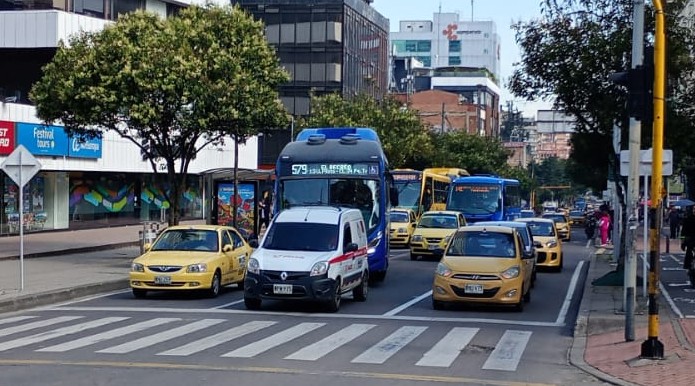
Replacement vehicles promise a smoother TransMilenio. But will they bring less commuter misery – and fresher air – to one of the planet’s most congested cities? Here’s a quick Q&A on recent twists in Bogotá’s tangled transport systems.
So, what’s the good news? OK, so 1,162 smoky old TransMilenio buses are being replaced with 1,441 brand new articulated ‘low-emission’ units with
Related: Transcending the TransMilenio.
Does ‘low emissions’ mean electric buses? Er, no. Half the new buses will be gas powered, and the other half ‘clean diesel’, if there is such a thing. That last detail sparked
But does diesel matter? Probably. According to a study by the Universidad Nacional in 2015, along Transmi routes – such as Caracas and the NQS – at least 70% of air pollution is caused by the current diesel-powered buses. A revamped fleet with 50% gas buses could lower particle emission and reduce the
Related: TransMilenio, a Painful Route to the Future.
Will all the old buses be destroyed? We wish. Unfortunately, some are being repainted blue and sent to El Salvador, supposedly a ‘donation’. Sounds like a smokescreen.
And what about car travel? No good news here, I’m afraid. In June we heard that Bogotá slipped to the world’s second-most congested place (after Bombay in India) in the annual Tom-Tom ‘traffic index’ of 403 world cities. During peak hours, car journeys in Colombia’s capital take around twice as long as normal driving time. Another traffic monitor, Inrix, calculates that Bogotá drivers spend on average 272 hours each year waiting in jams.
Should we be looking for other forms of transport then? Business folk can now be seen on electric scooters zipping through Bogotá’s plush northern suburbs. The nippy two-wheelers are hired from Grin, a Mexican tech-co joined with local food delivery (and everything else) gurus Rappi. But scooter freedom could be short-lived with the city’s Mobility Secretary soon to curb riders with a raft of regulations citing the Transport Code, the Master Mobility Plan and the Territorial Order Plan. Plus, a payment to the city for use of public space. Ouch.
Related: Going to Paradise on Bogotá’s TransMiCable
But surely the crowded city welcomes creative transport alternatives? Perhaps, but don’t ask the skateboarders heading down Bogotá’s Septima las month to celebrate World Skate Day. In an incident widely viewed on social media, police on motorbikes purposefully ran down some kick-flippers, who then attacked the police with their skateboards. Ouch and double-ouch!
Crikey! Is there any light at the end of the tunnel? Unfortunately, no new tunnels either. But last month Bogotá’s long-awaited Metro system – it’s been decades in the planning – took a step closer to reality by opening quotes internationally for construction of the 24-kilometre raised light rail track that will cross the city with 16 stations. Interested parties have until September to present plans for building and running the mass transit system. According to one expert estimate, the finished Metro will save commuters 280 million hours a year. More time to dream.

And what about bicycles? What about them? Oh yes, nearly forgot. OK, London may have its famous Tube – long the envy of